

Electric Torque. For decades, the sound of technical rock crawling was the roar of a high-displacement V8, the whine of a supercharger, and the frantic clicking of a winch.
But as we move through 2026, the silence of the trail is becoming the new standard for performance. Electric vehicles (EVs) have moved beyond being “eco-friendly commuters” and have cemented their place as the ultimate tools for technical rock crawling.
The secret lies in the unique physics of Electric Torque. Unlike internal combustion engines (ICE), which require a complex dance of RPMs, gear ratios, and torque converters to find their power, electric motors provide a level of surgical precision that is fundamentally changing how drivers approach a vertical rock face.
1. Zero-RPM Peak Torque: The Game Changer
In a traditional gas-powered crawler, torque is a “curve.” You have to rev the engine to hit the sweet spot where the vehicle has enough power to move over a boulder. This often leads to wheel spin—the enemy of traction.
The Instant Response
Electric motors deliver 100% of their available torque at 0 RPM. The moment you touch the accelerator, the force is there.
- No More Stalling: In 2026, the concept of “stalling” on a steep incline is a relic of the past.
- Finite Control: Drivers can now move their 6,000-pound rigs in increments of millimeters. This allows for a “crawl” so slow and steady that it looks like time-lapse photography, ensuring the tires bite into every micro-crevice of the rock.
Millisecond Modulation
Modern 2026 EV controllers can adjust the power output to the wheels thousands of times per second. If a tire begins to lose grip, the computer can reduce torque faster than any human foot could ever react, maintaining traction where a gas engine would simply spin and “dig a hole.”
2. Quad-Motor Independence and Virtual Locking
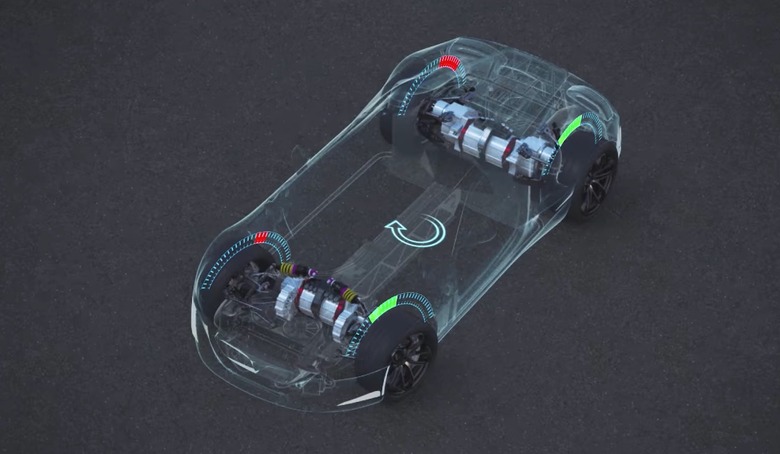
The most advanced crawlers of 2026, like the Rivian R1 Gen 2 Quad-Motor and the GMC Hummer EV, have moved away from traditional mechanical lockers. Instead, they use independent motor control.
True Torque Vectoring
With a motor dedicated to each wheel, the vehicle doesn’t need a heavy central driveshaft or mechanical locking differentials.
- Virtual Lockers: The software mimics a locked differential by ensuring all four wheels turn at the exact same speed, or it can send 100% of the power to just one single wheel if that’s the only one with traction.
- King Crab Mode: New for 2026, vehicles like the Hummer EV feature “King Crab” steering, where the rear wheels steer faster than the front. Combined with independent wheel torque, this allows a vehicle to pivot around a single point, making tight “impossible” turns on a narrow ridge a reality.
3. The End of “Brake Throttle” Driving
In a gas vehicle, “two-foot driving” is a skill every crawler must master—using the brake to hold the vehicle while simultaneously applying the gas to build torque. In 2026, One-Pedal Driving has replaced this struggle.
Regenerative Braking as a Tool
EVs use regenerative braking to slow down, which acts as a built-in “hill descent” and “hill hold” system.
- Steep Descents: On the way down a technical drop, the electric motors act as generators, providing a smooth, consistent resistance that is far more stable than traditional friction brakes.
- Hill Hold: When you let off the pedal on a 60-degree incline, the electric motors hold the vehicle perfectly still. There is no “rollback,” which is often the cause of rollovers in traditional rigs.
4. Center of Gravity and Chassis Stability
The weight of an EV is often cited as a downside, but in rock crawling, weight is your friend—if it’s in the right place.
The Skateboard Architecture
In 2026, battery tech (like the high-nickel Ultium cells or solid-state prototypes) is packed into the floor of the vehicle. This creates a low center of gravity that makes the vehicle incredibly “planted.”
- Side-Hilling: An electric crawler can handle much steeper side-slopes (tilting the vehicle sideways) than a top-heavy gas truck with a heavy engine block sitting high in the chassis.
- Underbody Armor: Because the battery is the floor, manufacturers have integrated heavy-duty skid plates that act as a “smooth belly.” This allows the vehicle to slide over rocks that would snag the axles or exhaust pipes of an ICE vehicle.
5. Thermal Management in 2026
A major hurdle for early electric crawlers was heat. Slow, high-torque movement generates massive amounts of heat in the motors and battery.
The 2026 generation of vehicles has solved this with Oil-Cooled Motors and Active Thermal Pre-Conditioning. Even when grinding up a rock garden in 100°F (38°C) heat, these systems keep the drivetrain in the optimal temperature window, preventing the “limp mode” that plagued earlier EV prototypes.
6. The Quiet Revolution: Sensory Awareness
One of the most underrated benefits of electric rock crawling is the silence.
- Hearing the Rocks: Without an engine roaring, the driver can hear the tires struggling for grip, the sound of the suspension articulating, and even the “chirp” of the rubber against the stone. This provides a new sensory feedback loop that helps the driver adjust their line in real-time.
- Spotter Communication: Communication between the driver and the “spotter” (the person outside the vehicle guiding the line) is now effortless. No more shouting over an exhaust; a calm conversation makes for a much safer and more successful climb.
Conclusion
Technical rock crawling has always been a game of inches and “feel.” By removing the lag of internal combustion and replacing it with the surgical, instant precision of electric motors, 2026 has marked the beginning of a new era. The “Most Capable” rigs on the trail today aren’t the ones making the most noise—they are the ones using the silent, relentless power of electric torque to redefine what is “climbable.”